Wedding Outfit Ideas for the Bride's or Groom's Sister and Family
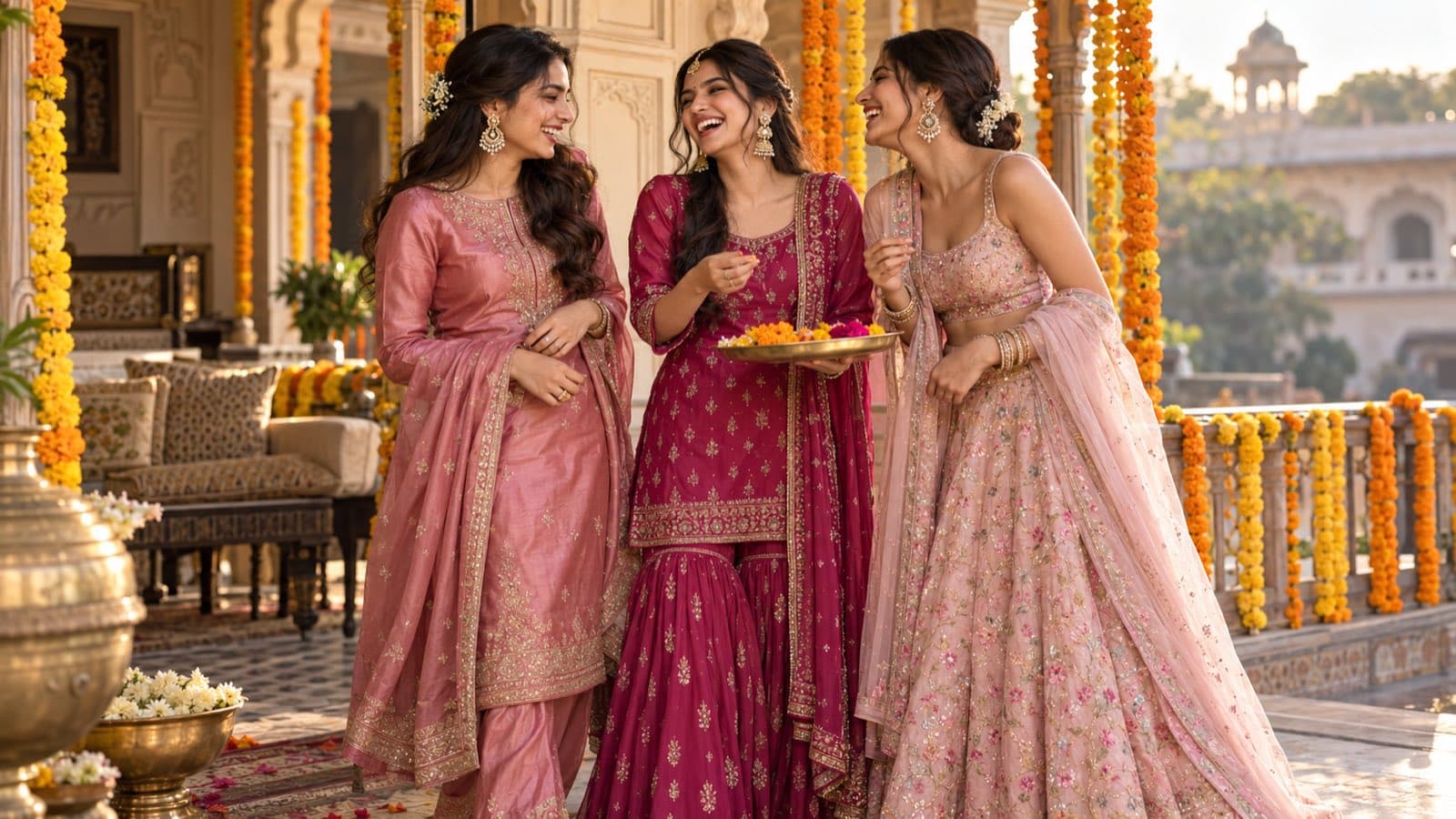
Outfit ideas for the groom's sister, cousins and close family: how to stand out from the guests without competing with the bride, follow a family colour theme, and plan every function.
If you are the bride's or groom's sister, a cousin or close family, dress one clear step above the guests and one clear step below the bride. In practice that means richer fabric and more embellishment than an ordinary guest outfit, a colour that sits beside the family theme rather than matching the bride, and a silhouette you can work, dance and sit in for hours. Plan every function together as a set, so you repeat nothing by accident and never end up in the bride's colour.
Key takeaways
- Family dresses one step above guests and one step below the bride, in fabric, embellishment and colour depth.
- Never wear the bride's exact shade or a near-copy of her silhouette; a neighbouring shade from her palette looks coordinated instead.
- If the family has a colour theme for a function, follow it with your own fabric, cut or dupatta so the photographs look planned rather than uniform.
- The groom's side often wears its strongest looks to the baraat and the reception; the bride's side to the sangeet and the wedding night.
- Plan all functions on one sheet with colour, outfit, footwear and bag, so nothing repeats and nothing clashes with the bride.
- Choose outfits with ease of movement, because family stands, carries, greets and dances far more than any guest.
Family vs guest vs bride: where your outfit should sit
A guest can wear almost anything festive. The bride is the focal point. Close family sits in between: you appear in more photographs than any guest, you play a part in the rituals, and you are seen beside the bride all day.
| Guest | Close family (sister, cousin, aunt) | Bride | |
|---|---|---|---|
| Embellishment | Light to medium | Medium to rich, never heavier than the bride | The heaviest in the room |
| Fabric | Anything festive | Silk blend, dupion silk, organza, brocade | Usually the richest silks and heavy work |
| Colour | Free, avoiding bridal red and white | A shade beside the bride's palette or the family theme | Her choice, often red, pink or a deep jewel tone |
| Silhouette | Any | Lehenga, sharara or anarkali, but not a copy of hers | Usually a bridal lehenga or saree |
| Practicality | Can be impractical | Must allow walking, carrying, sitting and dancing | Assisted all day |
| Number of looks | One per function attended | One per function, sometimes a change within one | A look per function |
If you are specifically the bride's sister, our sister of the bride outfit guide goes function by function through that role. This post covers the rest of the family too: the groom's sister, cousins on both sides, and aunts and sisters-in-law who want to look festive without looking bridal.
How to stand out from the guests without competing with the bride
The goal is to look like family in every photograph, not like a second bride.
- Go richer in fabric, not in colour. A dupion silk or an organza anarkali reads more formal than a cotton set, even in a soft shade. Fabric is the quietest way to stand above the guest line.
- Keep embellishment a level below hers. If the bride wears heavy zardozi, choose thread work or gota patti. If she wears thread work, a few sequins on you are fine.
- Never copy her silhouette and colour together. A lehenga is fine. A lehenga in her exact red, with a similar border, is not.
- Avoid her shade, white and bright bridal red unless the family has asked for them. Wine, rose, magenta and deep pink are safer neighbours.
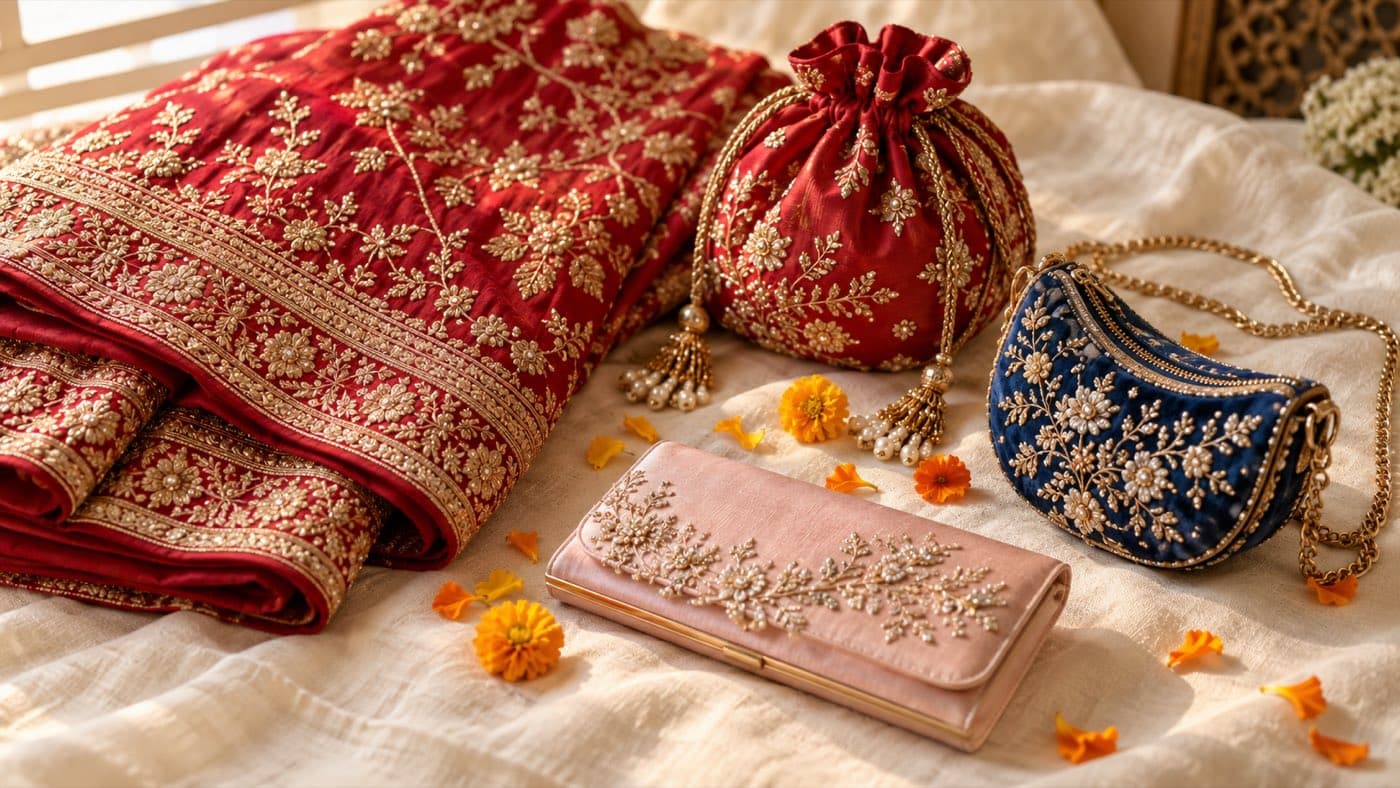
- Let one piece carry the look. A statement dupatta or a heavy potli is enough; a heavy kurta, a heavy dupatta and statement jewellery together compete with the bride.
Outfit ideas for the groom's sister
The groom's sister has her own moments: the haldi on the groom's side, the baraat, welcoming the bride into the family and, often, the reception the groom's family hosts.
- Baraat: this is your dancing function, often outdoors and moving. A sharara or a lehenga that clears the floor works best, in a festive colour such as magenta, emerald or rose.
- The wedding: dress richer than for the baraat, but quieter in colour than the bride. A dupion silk kurta set or a ready-to-wear lehenga with a lighter dupatta suits a long ceremony.
- The reception: usually the groom's family's biggest evening, and the one where you can wear your strongest look, still keeping it a step below the couple.
For the groom's side in stock:
- The magenta embroidered sequinned kurta with sharara and dupatta at ₹2,304 is a silk blend sharara set made for the baraat or the sangeet.
- The pink embroidered thread work lehenga and blouse with dupatta at ₹3,886 is a ready-to-wear lehenga for the wedding night that is festive without being bridal.
Outfit ideas for cousins and sisters-in-law
Cousins and sisters-in-law are often the ones running between rooms, handling the mehendi queue or managing the sangeet playlist. You want something that photographs well and lets you move.
- Choose a kurta set with a dupatta you can pin. You will be bending and carrying, and a pinned dupatta stays put.
- Coordinate with the other cousins. A shared colour family, such as all pinks or all jewel tones, looks planned in group photographs without everyone wearing the same outfit.
- Pick one rich set and rewear it. A dupion silk or organza set can appear at two functions with a change of dupatta and jewellery. Our guide to repeating one kurta set across three functions shows how.
For cousins in stock:
- The pink mirror work dupion silk kurta with trousers and dupatta at ₹5,999 has mirror work that catches light at a night function, rich enough for family photographs.
- The rose embroidered thread work kurta with trousers and dupatta at ₹2,704 is a silk blend set in a soft shade that coordinates with most family palettes.
- The yellow embroidered thread work kurta with trousers and dupatta at ₹2,704 is a silk blend set for the haldi, festive enough for family but practical for a messy ritual.
Coordinating with a family colour theme
Many families now pick a colour for each function: yellow for the haldi, green for the mehendi, pastels for the day ceremony, jewel tones for the sangeet. Following a theme without looking like a uniform is a simple matter of varying everything else.
- Vary the shade. If the theme is pink, one cousin can wear rose, another magenta, another blush.
- Vary the silhouette. Sharara, palazzo set, anarkali and lehenga in the same colour family look rich together.
- Use the dupatta to join in. If you cannot find the theme colour in an outfit you like, a dupatta in that colour over a neutral or contrasting set is enough.
- Check what the bride is wearing first. The theme is for the family; the bride often wears a contrasting colour so she stands out. Do not land in her shade.
Planning outfits for several functions
Family members attend every function, so plan them as one wardrobe rather than one outfit at a time.
| Function | Outfit type | Colour idea | Practical note |
|---|---|---|---|
| Haldi | Silk blend or cotton kurta set | Yellow, mustard, soft green | Expect stains; pin or skip the dupatta |
| Mehendi | Sharara or palazzo set with a short kurta | Green, teal, or the theme colour | Keep sleeves short or rolled for henna |
| Sangeet | Sequinned sharara or embroidered co-ord | Magenta, emerald, jewel tones | A hem that clears the floor for dancing |
| Baraat or wedding | Ready-to-wear lehenga or dupion silk kurta set | A shade beside the bride's palette | Pin the dupatta at shoulder and waist |
| Reception | Organza anarkali, lehenga or rich co-ord | A colour you have not yet worn that week | Comfortable footwear for long greetings |
A few planning habits help:
- Write it down. One note with function, outfit, dupatta, footwear and bag stops you repeating a colour in consecutive photographs.
- Share it with the family. A quick message in the family group avoids two sisters arriving in the same shade.
- Try every outfit on before the week. Check the fit with the size chart early, so there is time for returns or alterations.
For the reception in stock:
- The olive embroidered anarkali kurta with palazzos and dupatta at ₹5,304 is an organza anarkali in an earthy shade that rarely clashes with bridal colours.
- The multicolour embroidered potli clutch at ₹3,333 goes with almost every outfit on the list, so one bag covers the whole wedding.
Browse more options in kurta sets and lehenga choli. Shipping is free over ₹799 and you have 7-day returns.
Related guides
- What to Wear to a Roka or Sagai at Home: Bride, Family and Guests
- Wedding Season 2026 Outfit Ideas for Women: Guest Looks by Function
- What to Wear for a Court Marriage: Outfit Ideas for Bride and Guests
Frequently asked questions
What should the groom's sister wear to the wedding?
A dupion silk kurta set or a ready-to-wear lehenga in a shade beside the bride's palette works well. Keep the embellishment a step below the bride's and pin the dupatta so you can move freely during the rituals.
How can I stand out at my sister's wedding without outshining the bride?
Choose a richer fabric than the guests, such as dupion silk or organza, but keep the colour and embellishment quieter than the bride's. Avoid her exact shade and silhouette, and let one piece, such as the dupatta, carry the look.
What should cousins wear to an Indian wedding?
Cousins usually wear festive kurta sets, sharara sets or light lehengas, coordinated in a shared colour family for group photographs. Pick outfits you can move in, because cousins often help run the functions.
Should the bride's family and groom's family wear matching colours?
Not necessarily. Some families agree on a theme for each function, but each side usually chooses its own. If there is a theme, follow it by varying the shade and silhouette, and check the bride's outfit so you do not match her.
Can family members wear a lehenga to the wedding?
Yes, a lehenga is a common choice for close family. Choose one that is lighter in embellishment than the bride's and in a different colour, so it looks festive without looking bridal.