Sharara vs Gharara vs Palazzo: The Difference, Explained
Three wide-legged bottoms compared side by side: where each one flares, how much fabric it uses, the occasion it suits, which works for a wedding and how to wear each on a petite frame.
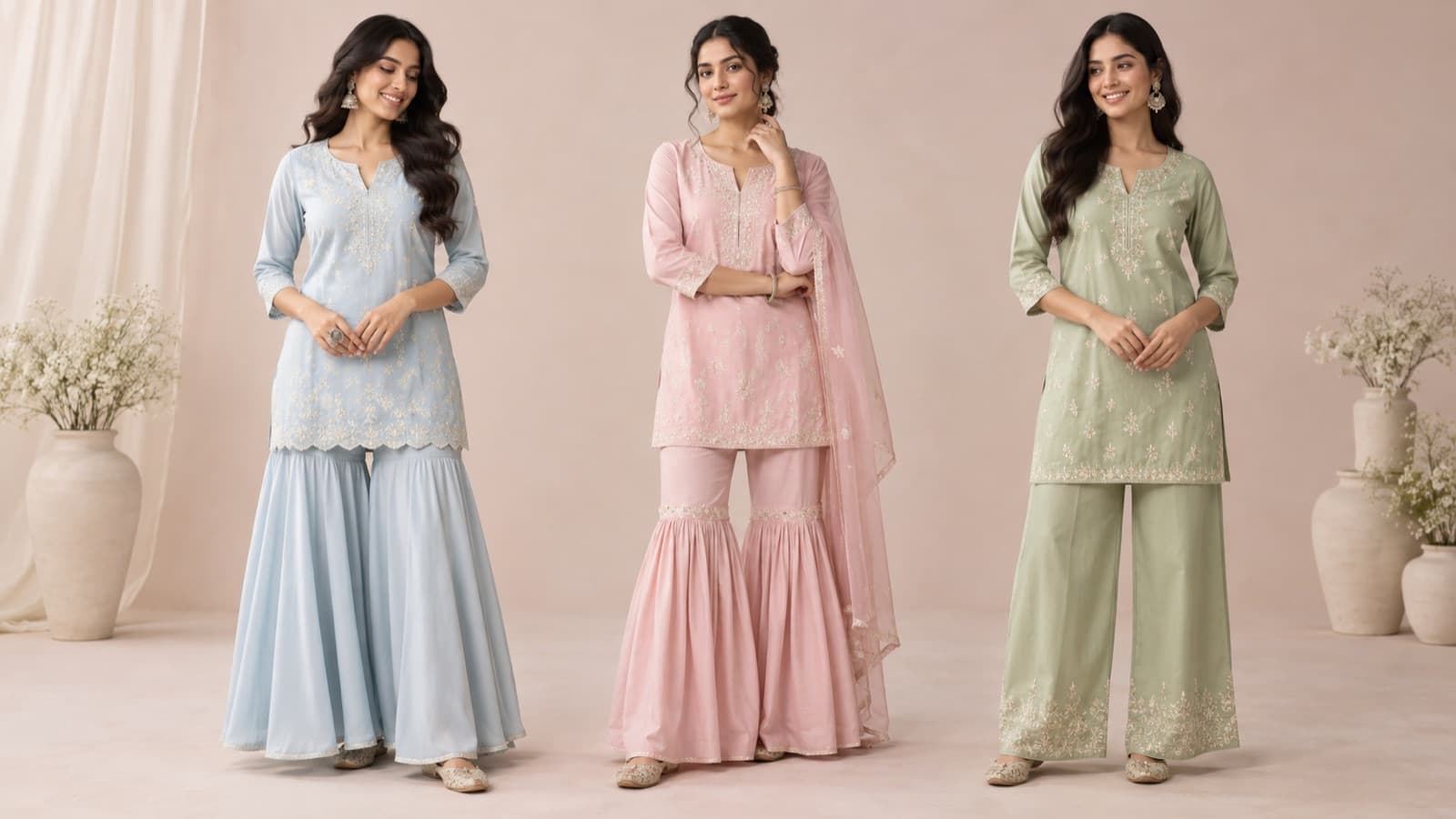
A sharara is a wide-legged bottom that flares out from the waist or hip. A gharara is fitted down to the knee, where a seam or band joins it to a deep flare. A palazzo is a loose, straight-cut wide-leg trouser with far less volume. Sharara and gharara are for occasions; palazzos work every day.
Key takeaways
- The quickest way to tell them apart is the knee: a gharara has a seam or band there, a sharara and a palazzo do not.
- A sharara flares from the waist or hip; a gharara is fitted to the knee and flares below it; a palazzo falls straight with gentle width.
- The gharara uses the most fabric of the three and is the most formal, a traditional choice for weddings and nikah ceremonies.
- Shararas suit mehendi and sangeet because the high flare moves when you dance; palazzos suit office, travel and everyday wear.
- Shararas and ghararas are usually worn with a short kurti, while palazzos work with a kurta of almost any length.
Sharara vs gharara vs palazzo: the comparison table
| Sharara | Gharara | Palazzo | |
|---|---|---|---|
| Cut | Wide-legged, flaring from the waist or hip | Fitted to the knee, then flared, with a joint at the knee | Straight wide leg, loose from waist to hem |
| Flare | Full, from the top | Dramatic, below the knee only | Gentle; falls straight |
| Fabric used | A lot | The most of the three | The least |
| Usual kurta | Short kurti, often above the knee | Short kurti | Any length, from hip to calf |
| Occasion | Mehendi, sangeet, Eid, festive evenings | Weddings, nikah, formal family functions | Office, everyday, travel and festive |
| Height | Works on most frames; a short kurti suits petites | Easiest on taller frames, where the knee joint sits right | Works on everyone; matching colours lengthen the leg |
| Fabric it needs | Silk blend, georgette, organza | Silk, brocade, heavier festive weaves | Cotton, cotton blend, crepe, silk blend |
The quickest way to tell them apart is to look at the knee. A gharara has a visible joint there, often finished with a band of gota or embroidery. A sharara and a palazzo do not.
What is a sharara?
A sharara is a pair of very wide-legged pants that flare out from the waist or upper hip, so the bottom looks almost like a divided skirt when you stand still. It is traditionally worn with a short kurti and a dupatta, and it has its roots in the courtly dress of Awadh, in and around Lucknow.
Because the flare starts high, a sharara moves beautifully when you walk or dance, which is why it has become a favourite for mehendi and sangeet. It also sits comfortably on the floor, which matters at a long seated function.
Sharara sets in stock:
- The green embroidered silk blend kurta with sharara and dupatta pairs an above-knee thread-work kurta with a solid sharara.
- The red embroidered silk blend kurta with sharara and dupatta is the same cut in red, a strong choice for a festive evening.
- The red embroidered silk blend kurti with sharara and dupatta has a round neck and a drawstring sharara.
- The black gotta patti silk blend kurta with sharara and dupatta has three-quarter sleeves and a calf-length kurta, for anyone who prefers more coverage.
What is a gharara?
A gharara is fitted from the waist down to the knee. At the knee, a seam joins it to a deep, gathered flare that falls to the floor. That joint is often covered with a band of gota or embroidery, and it is the defining detail of the garment.
The gharara is the most formal of the three and uses the most fabric. It is a traditional choice for weddings and nikah ceremonies, especially in Lucknow and Hyderabad, and it is usually made in silk or a heavy festive weave.
It is also the hardest of the three to wear. The knee joint needs to sit at your actual knee, so length and fit matter more than with a sharara or palazzo. If you are petite, have it altered rather than wearing it long.
Labels are loose in practice: the words sharara and gharara are often used interchangeably, even by sellers. Look at the photographs. If there is no seam at the knee, it is a sharara.
What is a palazzo?
A palazzo is a wide-leg trouser that falls straight from the waist to the ankle. It is loose and comfortable but uses far less fabric than a sharara and has no dramatic flare. It works with a kurta of almost any length, which is why it is the most common bottom in kurta sets today.
Palazzos are the everyday option. In cotton or a cotton blend they suit the office and travel. In silk blend or organza, with a dupatta, they are dressy enough for a festive function.
Palazzo sets in stock:
- The sea green embroidered organza kurta with palazzos and organza dupatta is a festive palazzo set at ₹1,999.
- The pink embroidered silk blend kurta with palazzos and dupatta works for a puja or a family function.
- The rust floral printed chanderi cotton kurta with palazzos and dupatta sits between everyday and festive.
- The green printed pure cotton kurta with palazzos and dupatta is the everyday, washable end of the range.
Browse all kurta sets and co-ords.
Which to choose for a wedding
- Mehendi or sangeet: a sharara. It moves when you dance and sits comfortably on the floor.
- The wedding or a nikah: a gharara if you want the most traditional look, or a sharara in silk blend if you want something easier to wear.
- Reception or a family dinner: a festive palazzo set with a dupatta, or a sharara set.
- Several functions on one trip: palazzo sets pack smaller and can be restyled with different jewellery.
Our Indian wedding guest outfit guide goes through each function in more detail, and our sangeet outfit ideas focus on dance-friendly looks.
Sharara, gharara or palazzo for short height
All three can work on a petite frame. A few rules make them easier:
- Pair a sharara with a short kurti so the eye reads a longer leg. Most sharara sets already come this way.
- Get a gharara's knee joint to sit at your knee. If it sits lower, it makes the leg look shorter.
- Wear palazzos in the same colour as the kurta to create one long vertical line.
- Add a small heel or platform under a floor-length sharara or gharara so the hem does not drag.
For help with fit, see our size chart and our guide to finding your size without guessing. Shipping is free over ₹799 and you have 7-day returns if the fit is not right.
Related guides
- Kurta Necklines Explained: Round, V, Boat, Mandarin, Sweetheart
- A-Line vs Anarkali vs Straight Kurta: The Difference (with Table)
- Dress Types Explained: A-Line, Fit and Flare, Shirt, Maxi, Bodycon
Frequently asked questions
Sharara meaning: what is a sharara?
A sharara is a pair of very wide-legged pants that flare out from the waist or upper hip, so they look almost like a divided skirt. The word is used for the bottom itself and, loosely, for the whole kurti, sharara and dupatta set. It comes from the courtly dress of Awadh, around Lucknow.
What are gharara pants?
Gharara pants are fitted from the waist to the knee, where a seam joins them to a deep, gathered flare that falls to the floor. The knee seam is usually covered with a band of gota or embroidery. They are worn with a short kurti and dupatta, mostly at weddings and nikah ceremonies.
What is the difference between a sharara and a gharara?
A sharara flares out from the waist or hip, so it is wide all the way down. A gharara is fitted to the knee and then flares, with a visible seam or band at the knee joining the two parts.
Palazzo vs sharara: which should I choose?
Choose a palazzo for everyday, office and travel wear, because it falls straight, uses less fabric and works with a kurta of any length. Choose a sharara for a mehendi, sangeet or festive evening, because its full flare from the hip moves beautifully and reads as occasion wear.
Which is better for a wedding, a sharara or a gharara?
A gharara is the more traditional and formal choice, especially for a nikah. A sharara is easier to wear, easier to fit and better for dancing, so it suits a mehendi or sangeet.
Can short women wear a sharara?
Yes. Pair it with a short kurti, keep the hem just off the floor and add a small heel. A sharara is usually easier for petite frames than a gharara, whose knee joint has to sit exactly right.
Are palazzos good for office wear?
Yes. Cotton or cotton blend palazzos with a straight or A-line kurta are comfortable for a full working day and look neat at a desk.