A-Line vs Anarkali vs Straight Kurta: The Difference (with Table)
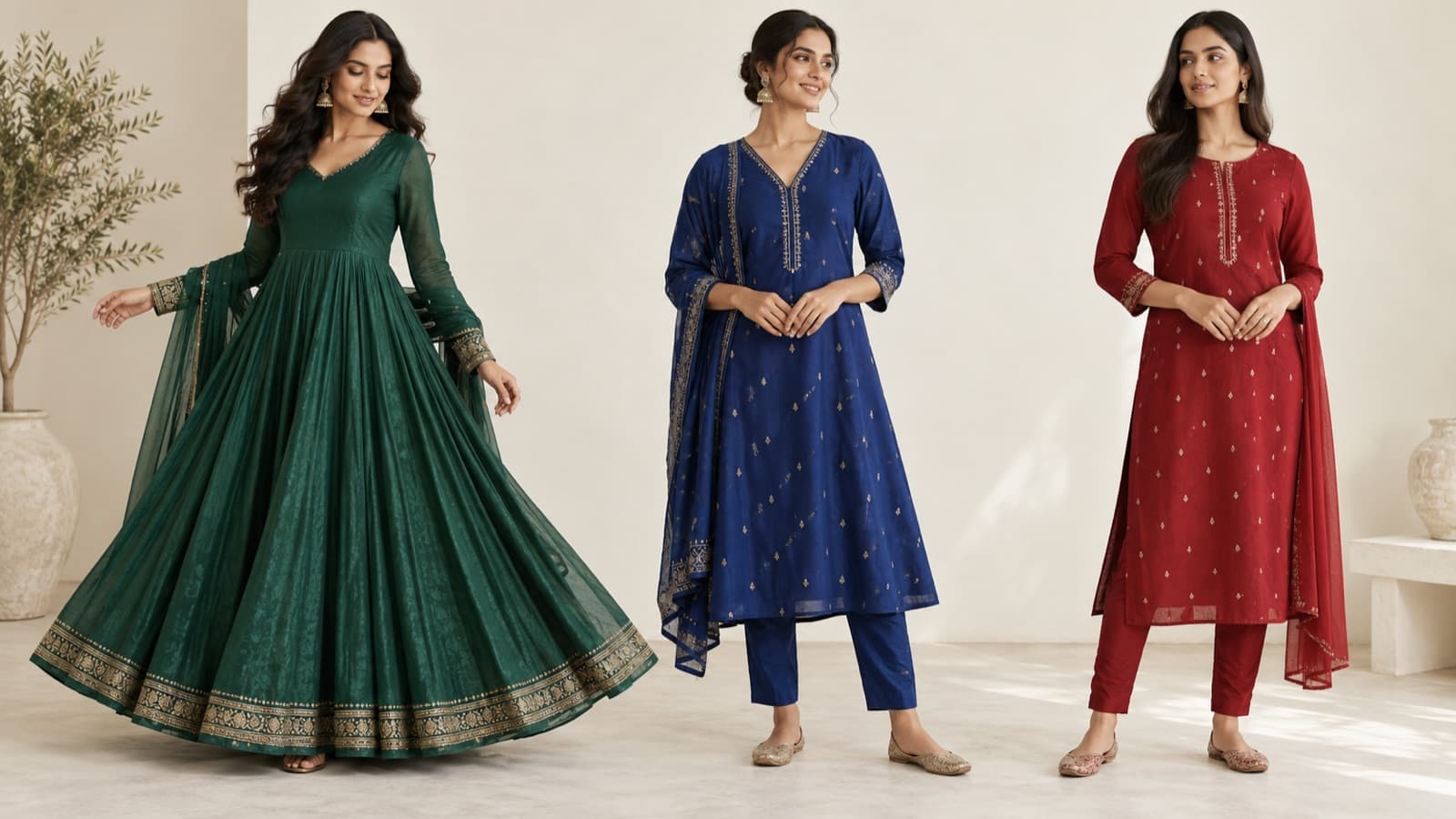
The three kurta cuts compared side by side: fit, flare, length, the occasion each suits and the fabric each one needs, plus Anarkali vs angrakha and what works for a petite frame.
An A-line kurta is a kurta that is fitted at the shoulders and widens gradually to the hem, like the letter A. A straight kurta is a kurta that falls in a vertical line from the shoulder with little or no flare. An Anarkali is a long kurta that is fitted to just below the bust and then flares out in panels or pleats, usually to calf or ankle length. Choose straight for work, A-line for versatility and Anarkali for occasions.
Key takeaways
- An A-line kurta widens steadily from the chest to the hem; a straight kurta has almost no flare; an Anarkali flares hard from just below the bust.
- The real difference between A-line and Anarkali is where the flare starts: at the chest for an A-line, at the empire line under the bust for an Anarkali.
- Straight kurtas usually end between the hip and the knee, A-lines between the knee and the calf, and Anarkalis between the calf and the ankle.
- An Anarkali needs a fabric that holds volume, such as organza, georgette, chanderi or silk blend; a heavy cotton falls flat.
- The A-line is the most forgiving cut for wider hips and the easiest single kurta to wear from office to a family function.
- For petite frames, a straight or A-line kurta at or just above the knee lengthens the leg line best.
A-line vs Anarkali vs straight kurta: the comparison table
| Straight | A-line | Anarkali | |
|---|---|---|---|
| Fit at the top | Follows the shoulder and chest, then falls straight | Fitted at the shoulder and chest | Fitted to just below the bust |
| Flare | None, or very little | Gradual, widening steadily to the hem | Full and dramatic, often with panels or pleats |
| Usual length | Hip to knee | Knee to calf | Calf to ankle |
| Best for | Office, travel, everyday | Almost anything, from work to a family function | Weddings, festivals and evening functions |
| Pairs with | Trousers, cigarette pants, palazzos | Trousers, palazzos, leggings | Churidar, fitted trousers |
| Body type | Suits lean and rectangular frames; reads clean and tall | The most forgiving cut; balances wider hips | Defines the waist; flatters pear and hourglass frames |
| Fabric it needs | Crisp cotton, cotton blend, crepe | Mid-weight cotton, silk blend, rayon | Organza, georgette, silk blends and chanderi that hold volume |
The quickest way to decide is not your body type but the occasion. Body shape narrows the field a little. Where you are going decides it almost entirely.
A-line vs Anarkali: the key difference
Both cuts flare, which is why they are so often confused. The difference is where the flare starts and how much of it there is. An A-line kurta is fitted only at the shoulder and chest and then widens gently and evenly, so it looks neat enough for a desk. An Anarkali is fitted through the bodice to just below the bust and then flares out in a full skirt of panels or pleats, so it reads as occasion wear and uses several times more fabric.
If you can see a seam under the bust with a gathered or pleated skirt below it, it is an Anarkali. If the side seams simply run outwards from the armhole to the hem, it is an A-line.
A-line vs straight kurta: which to choose
A straight kurta keeps the same width from chest to hem, while an A-line gets wider towards the hem. Choose a straight kurta for a sharp, formal look with trousers or cigarette pants, and if you have a lean or rectangular frame. Choose an A-line if you want room at the hip, more movement when you walk, or one kurta that dresses up and down.
Straight kurta
A straight kurta falls in a more or less vertical line from the shoulder. It is the quietest of the three cuts, the easiest to wear to work and the most dependent on fabric: in a crisp cotton it looks structured, and in a soft blend it looks relaxed.
It is also the shape that most rewards getting the size right. A straight cut has nowhere to hide an extra inch in either direction, so check the bust and hip measurements in our size chart before you order.
Shop straight kurta sets:
- Navy blue floral printed straight kurta set, cotton blend
- Black floral printed V-neck straight kurta with trousers and dupatta, cotton blend
A-line kurta
An A-line is fitted through the shoulder and chest and widens steadily to the hem, so the outline looks like the letter A. It is the most forgiving of the three, it moves well, and it works over both trousers and palazzos.
If you are buying one kurta and do not want to think about it again, buy the A-line. It looks deliberate whether you pair it with flats on a weekday or with heels at a function.
Shop A-line kurta sets:
- Off-white floral printed V-neck A-line kurta with trousers, cotton blend
- Off-white floral printed round-neck A-line kurta with trousers, cotton blend
Anarkali kurta
The Anarkali is fitted to just below the bust and then flares hard. It uses a lot of fabric, it moves a lot, and it sends a clear occasion signal. Nobody wears an Anarkali to a desk by accident.
The flare is the point, so fabric matters more here than anywhere else. Organza, georgette and silk blends hold the shape. A heavy cotton sits flat and loses the whole effect.
Shop Anarkali kurtas and sets:
- Turquoise blue embroidered pleated organza Anarkali kurta with trousers and dupatta
- Olive embroidered organza Anarkali kurta with palazzos and dupatta
- Blue floral jacquard chanderi silk Anarkali kurta, a single kurta to pair with your own bottoms
Anarkali vs kurta: what sets it apart
An Anarkali is a kind of kurta, so the real comparison is Anarkali vs an everyday kurta. A regular kurta, whether straight or A-line, is cut as one piece from shoulder to hem and is worn for work, travel and daily life. An Anarkali has a separate fitted bodice and a flared skirt, is longer and fuller, and is worn to weddings, festivals and evening functions. Most Anarkalis come as a set with a churidar or fitted trousers and a dupatta.
Anarkali vs angrakha
People often confuse the two because both can be long and flared. The difference is the closure. An angrakha has an overlapping, wrap-style front that ties at the side, while an Anarkali is a closed, pullover or back-zip garment with a seam under the bust. An angrakha can be cut straight, A-line or flared, so it is a neckline and closure style rather than a silhouette. The black printed angrakha silk crepe kurta with trousers and dupatta is an example of the angrakha style.
Straight vs A-line kurta for short height
If you are petite, both straight and A-line cuts can work. The length matters more than the shape.
- Keep the hem at or just above the knee. A longer kurta shortens the leg line.
- Choose a straight cut with trousers in the same colour to create one long vertical line.
- Choose an A-line in a light fabric rather than a stiff one, so the flare does not add bulk.
- Avoid floor-length Anarkalis with a lot of flare, unless you will wear heels. A calf-length Anarkali is the easier option.
The question that settles it
Ask what the kurta is for, not only what suits you.
- Work, travel and everyday: straight or A-line, in a blend that does not crease.
- A function where you will be photographed: Anarkali, or an A-line in a silk blend.
- One kurta for both: A-line, mid-weight fabric, plain or with a small print.
Product titles on Tussra name the cut where the brand provides it, so searching for "A-line", "straight" or "Anarkali" is the quickest way to see what is in stock. You can also browse all kurta sets and single kurtas. Our guide to kurta fabrics explains which material suits which cut.
If the shape is wrong in person, you have 7-day returns from delivery, and shipping is free on orders over ₹799. Not sure of your size? See our guide to finding your size without guessing.
Related guides
- Kurta Set Colour Combinations That Always Work (Pairing Table)
- Kurta Necklines Explained: Round, V, Boat, Mandarin, Sweetheart
- Kurta Length Guide: Which Length Suits Your Height
Frequently asked questions
What does A-line kurta mean?
An A-line kurta means a kurta cut narrow at the shoulders and chest that widens gradually to the hem, so its outline looks like the letter A. It flares gently and evenly, without the gathered skirt of an Anarkali, which makes it easy to wear to work and to functions.
A-line vs Anarkali: what is the difference?
An A-line kurta is fitted at the shoulder and chest and widens gradually to the hem. An Anarkali is fitted only to just below the bust and then flares out much more, usually to calf or ankle length. The Anarkali is dressier and uses far more fabric.
What is the difference between A-line and straight kurta?
A straight kurta falls vertically from the shoulder with little or no flare. An A-line kurta widens steadily from the chest to the hem. The A-line is more forgiving around the hips, while the straight cut looks cleaner and more formal.
Is an Anarkali different from a kurta?
An Anarkali is a type of kurta, but it is cut differently from an everyday one. It has a fitted bodice to just below the bust and a full, flared skirt, while a regular straight or A-line kurta is cut in one piece with little flare. Anarkalis are usually worn for occasions.
Which kurta shape is best for short height?
Straight and A-line kurtas that end at or just above the knee usually work best for petite frames. Trousers in the same colour lengthen the leg line. If you choose an Anarkali, a calf-length one is easier to wear than a floor-length one.
Is an Anarkali suitable for office wear?
Usually not. An Anarkali's full flare signals an occasion, so it can look overdressed at a desk. Straight and A-line kurtas in cotton or a cotton blend are the more practical office choice.
Which fabric is best for an Anarkali?
Organza, georgette, chanderi and silk blends hold the flare and move well. Heavy cotton tends to fall flat, which loses the shape the Anarkali is known for.