Co-ord Set for Plus Size Women: Cuts and Fabrics That Flatter
How to choose a co-ord set for a plus size or curvy figure: the top lengths, bottoms, fabrics, colours and layers that flatter, plus how to find your size.
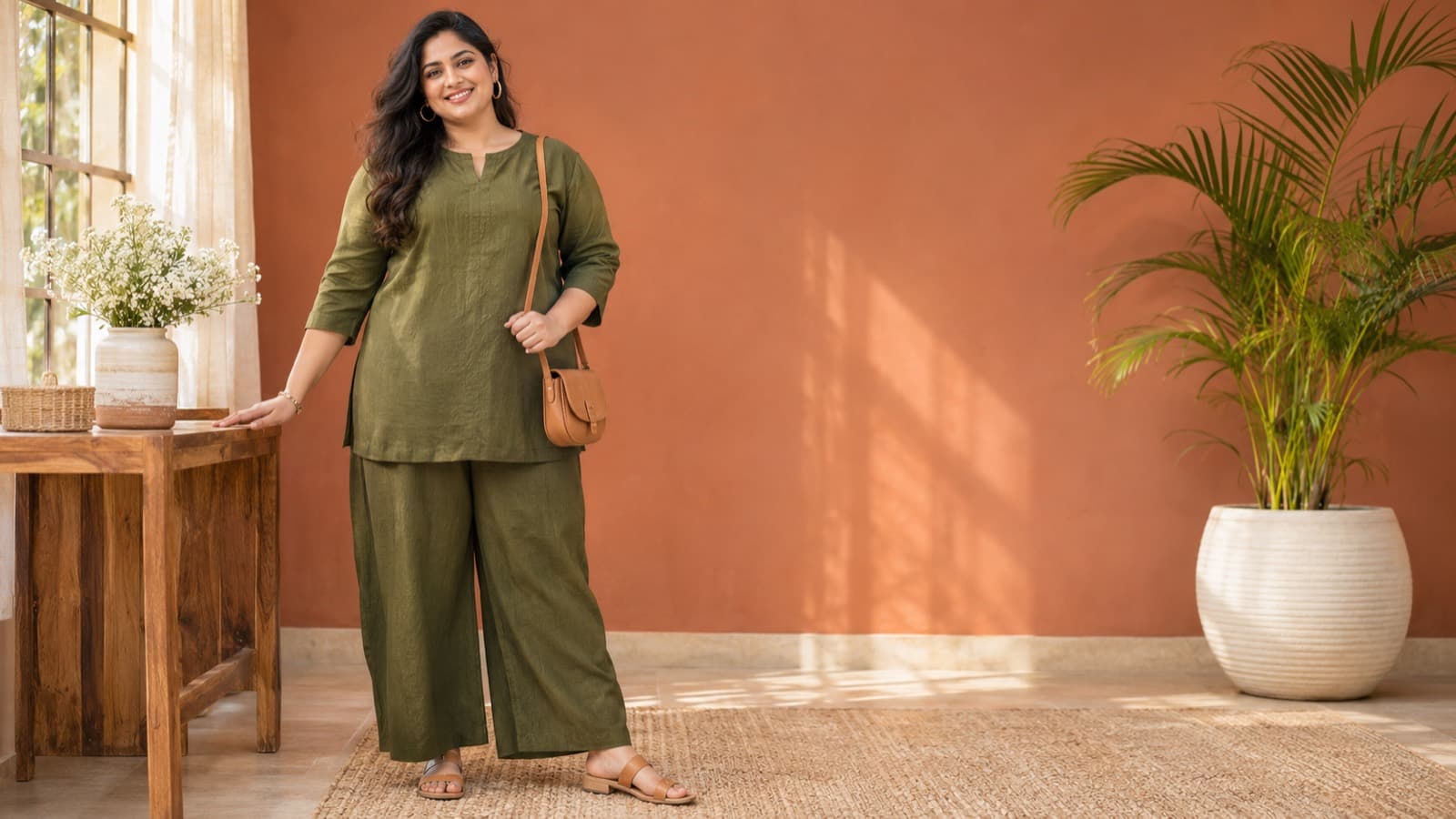
The most flattering co-ord sets for plus size women have a top that skims the body rather than clinging, a hem that ends at the hip or below, and a straight or wide-leg bottom that falls cleanly from the waist. Choose fabrics with drape and a little weight, such as poly georgette, silk blend and soft cotton, over stiff or very thin ones. Size the set by your largest measurement, and check the top and the bottom separately against the size chart before you order.
Key takeaways
- A tunic-length top that ends at the hip or mid-thigh is the easiest co-ord shape to wear on a fuller frame.
- Palazzos and straight trousers balance the hips better than tapered or cropped bottoms.
- Poly georgette and silk blend drape over curves; very thin, clingy knits show every line.
- A single colour from neckline to hem creates one long vertical line and reads taller and leaner.
- Size by your largest measurement (bust, waist or hip), then check the bottom's waist and hip separately.
- A third layer, such as a koti, shrug or blazer, adds structure without needing a tighter fit.
Why co-ord sets work well for plus size bodies
A co-ord set is a matching top and bottom made in the same fabric or print. That matching is what makes it useful on a curvy figure. The eye reads one continuous colour from shoulder to ankle instead of stopping at the waist, so the outfit looks longer and more streamlined than a top and bottom in two contrasting colours.
A co-ord also takes the guesswork out of pairing. You do not need to hunt for a bottom that matches the exact shade of a top, and the proportions have already been planned by the designer. If you are new to the format, our guide to what a co-ord set is and how to style one covers the basics.
The things that decide whether a co-ord flatters you are the cut of the top, the shape of the bottom and the fabric. Get those three right and almost any colour or print works.
Best co-ord cuts for plus size: quick-reference table
| Piece | Cuts that flatter | Cuts to be careful with | Why |
|---|---|---|---|
| Top length | Hip-length, tunic or mid-thigh | Cropped tops, waist-length boxy tops | A longer top covers the tummy and hip line and creates a longer vertical |
| Top shape | Straight, A-line, gently flared, shirt cut | Very fitted, heavy peplum at the widest point | Skimming fabric looks smoother than fabric pulled tight |
| Neckline | V-neck, notched, collared shirt, keyhole | High, tight round necks on a full bust | An open neckline lengthens the neck and breaks up the bust area |
| Sleeves | Three-quarter, elbow, loose full sleeves | Tight cap sleeves | Sleeves that end at a slim point of the arm look neater |
| Bottom | Palazzo, straight trouser, wide-leg pant | Tapered, cropped, skin-tight | A straight line from hip to ankle balances the top half |
| Fabric | Poly georgette, silk blend, soft cotton, crepe | Very thin jersey, stiff organza bottoms | Drape follows curves without clinging or adding bulk |
The top: length and shape matter most
The top is where most fit problems show. A tunic that reaches the hip or mid-thigh is the safest choice, because it falls past the widest part of the stomach and lands on a slimmer point of the leg. A top that stops exactly at the waist draws a horizontal line across the middle, which is usually the area people want to soften.
Look for a straight or slightly A-line shape. The fabric should hang from the bust and shoulders with a little room through the stomach. If you can pinch about two to three centimetres of spare fabric at the waist, the fit is right. If the top pulls across the bust or rides up when you sit, go one size up.
Peplum tops can work, but check where the flare starts. A peplum that flares just under the bust and falls past the hip is flattering. A peplum that sits exactly on the widest part of the hip adds volume there.
Tunic-style co-ords in stock:
- The blue floral printed cotton blend tunic co-ord at ₹1,426 has a longer tunic shape and a soft print, an easy everyday set.
- The white pure cotton printed tunic with trousers at ₹1,506 pairs a tunic with straight trousers, a breathable option for long days.
- The olive embellished silk blend tunic with palazzos at ₹1,586 is dressier, for a family function or dinner.
The bottom: palazzos and straight trousers
A wide or straight bottom is the plus-size co-ord's best friend. Palazzos fall from the waist without hugging the thigh, so they balance a fuller hip and make the leg look longer, especially when the hem nearly touches the floor. Straight trousers give a sharper, more office-ready line while still skimming rather than gripping.
Tapered and cropped trousers are harder. A taper narrows at the ankle, which can make the hip look wider by contrast, and a cropped hem cuts the leg line short. If you love a cropped trouser, wear it with a heel or a pointed flat to extend the leg.
When you try the bottom on, sit down. The waistband should not dig in, and there should be no pulling across the front. A trouser that fits standing but strains when seated is a size too small.
Palazzo and trouser co-ords in stock:
- The blue solid top with palazzos at ₹1,346 is a single-colour set, the simplest way to get one long vertical line.
- The black embroidered silk blend top with palazzos at ₹2,281 keeps the embroidery on the top and the palazzos plain, so the volume stays balanced.
- The peach embroidered blazer with trousers at ₹2,281 adds a blazer layer over straight trousers, a polished set for work events or a reception.
Browse every set in the co-ords collection.
Fabrics that flatter a fuller figure
Fabric decides how a cut actually behaves on the body. The same tunic shape can look smooth in one fabric and boxy or clingy in another.
- Poly georgette is light, flowing and slightly matte. It drapes over curves without sticking, and it travels well because it does not crease easily.
- Silk blend has more weight and a soft sheen. It falls in clean lines and holds embroidery well, so it is the fabric to choose for festive co-ords.
- Pure cotton and cotton blend are the most breathable. Cotton has little natural stretch, so leave a bit of ease in the fit and size up if you are between sizes.
- Organza is crisp and sheer. It suits a top or a layer, but a very stiff organza bottom can add width, so balance it with a softer piece.
Avoid very thin, stretchy fabrics that cling, because they show every line underneath. If a fabric looks transparent against your hand in daylight, it will need a slip or lining.
Colours and prints for plus size co-ords
There is no colour a curvy woman cannot wear. What changes the look is how colour is placed.
- One colour head to toe gives the longest, cleanest line. Navy, black, olive, wine and deep teal are classic, but a single bright colour works the same way.
- Medium to small prints spread evenly across the set look balanced. Very large prints placed on the hip or stomach draw the eye there.
- Vertical details such as a placket, a long front opening or embroidery down the centre lead the eye up and down rather than across.
- Keep the heaviest work near the face. Embroidery on the yoke, neckline or sleeves pulls attention upwards, and plain bottoms keep the lower half calm.
The cream organza self design tunic with palazzos at ₹1,266 shows how a tone-on-tone self design adds texture without a busy print.
How to add a layer without adding bulk
A third piece is the simplest way to add structure and shape. An open koti, a long shrug or an unbuttoned blazer creates two long vertical lines down the front of the body, which visually narrows the middle. It also covers the arms, if you prefer that, without needing a tighter top.
Keep the layer open and let it fall straight. Choose a length that ends at the hip or below, the same as the top. A cropped jacket over a long tunic stops the eye at the waist again.
For winter, the same idea works with a longer shawl or a fine knit cardigan in the same tone as the set, worn open so it falls in two straight lines.
How to find your co-ord size
Most co-ord fit problems come from sizing the set by the top alone. Measure three places, in centimetres or inches, with a soft tape:
- Bust: around the fullest part, tape level across the back.
- Waist: around your natural waist, where you bend sideways.
- Hip: around the fullest part of the seat.
Compare all three with the size chart and choose the size that fits your largest measurement. If your bust is one size and your hip is another, go with the larger one and have the smaller piece taken in if needed. Size options differ from product to product, so check the sizes listed on each product page before you order.
Our guide to finding your size without guessing walks through measuring step by step. Shipping is free over ₹799, and 7-day returns give you time to check the fit at home.
Styling plus size co-ords for different occasions
- Office: a single-colour set with straight trousers and a collared or shirt-style top, worn with loafers or block heels and a structured tote.
- Everyday and errands: a cotton tunic with palazzos and flat sandals. Add a crossbody bag to keep your hands free.
- Family function or puja: a silk blend or embellished tunic set with a light dupatta draped on one shoulder, which adds another vertical line.
- Evening or party: a dark embroidered set with metallic flats or heels, statement earrings and a small clutch.
For a deeper look at shape-specific choices in ethnic wear, see our guide to choosing a kurta set for your body shape.
Related guides
- Co-ord Set vs Kurta Set: Which Is Better and When to Wear Each
- Co-ord Set Outfit Ideas: One Set, Desk to Dinner
- How to Style a Dupatta With a Dress, Jeans or Co-ord Set
Frequently asked questions
Can plus size women wear co-ord sets?
Yes. Co-ord sets often suit plus size women very well, because one colour or print from top to bottom creates a long, unbroken line. Choose a hip-length or longer top, a straight or wide-leg bottom and a fabric with good drape.
Which co-ord bottom is best for a big tummy or wide hips?
Palazzos and straight-leg trousers are the most balanced choices. They fall cleanly from the waist without clinging to the thigh. Pair them with a tunic-length top that covers the stomach and ends past the hip.
What fabric is best for a plus size co-ord set?
Poly georgette and silk blend drape smoothly over curves, while pure cotton and cotton blend are the most breathable for daily wear. Avoid very thin, stretchy fabrics that cling, and very stiff ones that add width.
Should plus size women avoid crop top co-ords?
Not necessarily, but a crop top is the hardest co-ord style to wear on a fuller frame because it draws a line across the middle. If you want one, pair it with high-waisted palazzos that meet the hem, or wear an open long layer over it.
How do I choose the right size for a co-ord set?
Measure your bust, waist and hip, then match your largest measurement to the size chart. Check the bottom's waist and hip as well as the top's bust. If you are between sizes in cotton, choose the larger size.
Do printed co-ord sets make you look bigger?
Not if the print is chosen well. Small and medium prints spread evenly across the set look balanced, and tone-on-tone or self-design prints add texture quietly. Very large prints placed on the hip or stomach are the ones to be careful with.